What are common bearing failure modes? This question sits at the center of reliable machine maintenance. A bearing may appear simple, yet its failure often reflects several interacting conditions. Poor lubrication, contamination, misalignment, overload, electrical damage, and incorrect installation can leave different marks on the raceway and rolling elements.
Dr. Tedric A. Harris, a respected authority on rolling bearing analysis, emphasized a practical maintenance principle: “A bearing rarely fails without a reason.” That reason may be visible as blue heat discoloration, reddish-brown fretting, evenly spaced dents, or flaking fatigue cracks. It may also remain hidden inside a grease sample or behind an unnoticed shaft error. Small details matter.
This guide examines China’s top 10 common bearing failure modes through an engineering and maintenance perspective. It connects each mode with its typical appearance, operating cause, and corrective action. The discussion includes real workshop concerns, such as excessive preload, water entering a sealed housing, and a bearing installed with force applied to the wrong ring. These mistakes are common. They are also preventable.
Still, diagnosis is not always clean. One damaged bearing can show several symptoms at once. Lubricant starvation may accelerate wear, while misalignment creates uneven loading. A photograph alone can mislead. Accurate conclusions require operating history, shaft and housing measurements, lubricant inspection, and careful failure analysis. That is where experience matters. The goal is not merely replacing the bearing. It is identifying the condition that made replacement necessary.
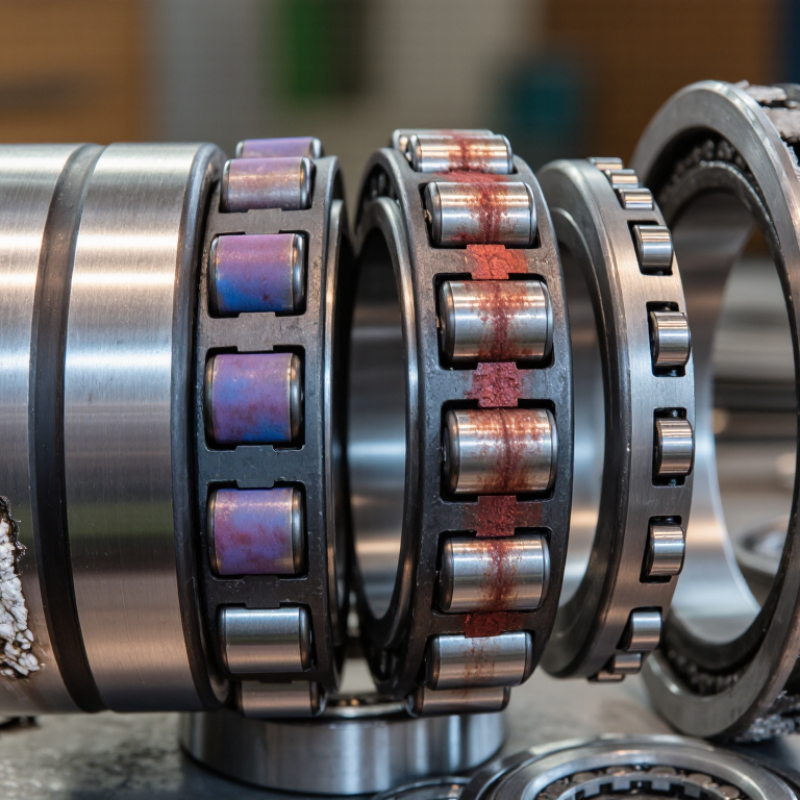
In Chinese factories, bearing failures often begin with small changes: a dry raceway, dusty grease, or rising vibration. A widely cited 36% benchmark links premature failures to inadequate lubrication. This makes lubrication the most practical starting point for maintenance teams. The other common modes include contamination, incorrect mounting, excessive load, misalignment, material fatigue, corrosion, electrical erosion, false brinelling, and fretting wear.
Each mode leaves physical clues. Milky grease can indicate water entry, while dark paste may show abrasive contamination. Dents around the raceway often reveal impact during installation. Uneven marks across the rolling path suggest misalignment or shaft deflection. Flaking surfaces point toward fatigue, especially under repeated shock loads. Rust-colored tracks require attention to humidity, storage, and seal condition. Electrical erosion creates small craters and may appear near motor-driven equipment.
In practice, Chinese facilities face mixed conditions. Steel dust, summer humidity, washdown water, and irregular loading can combine within one machine. Technicians should record temperature, vibration, lubricant condition, mounting force, and operating speed. Do not trust one symptom alone. A warm housing may indicate overload, poor lubrication, or excessive preload. That distinction is easy to miss.
Some inspections remain imperfect. Grease color is not a laboratory diagnosis. Vibration readings also depend on sensor position and operator skill. Still, consistent records can connect failure patterns with real operating conditions. A bearing removed from a dusty conveyor may show fretting near the fit, while a pump bearing may show corrosion beneath hardened grease.
This benchmark ranks common premature bearing failure modes by their estimated share of investigated failures. Lubrication-related problems account for the widely cited 36% benchmark; the remaining categories represent normalized industry failure-pattern estimates for comparison.
Lubrication, contamination, and incorrect mounting are the leading preventable causes. Proper lubricant selection, clean handling, accurate installation, alignment checks, and regular condition monitoring can significantly reduce premature bearing damage.
What Are China Top 10 Common Bearing Failure Modes?
Analyze Lubrication Failures, Which Cause About 36% of Bearing Damage
Lubrication failure remains the leading bearing damage mode. A widely cited industry failure-analysis report attributes about 36% of bearing damage to inadequate or incorrect lubrication. This includes lubricant starvation, excessive grease, wrong viscosity, and poor relubrication timing. ISO 15243 classifies related damage as smearing, surface distress, and wear. In practice, a dry raceway may show brown discoloration and fine scoring. Excess grease can raise temperature and force seals to leak. Both conditions shorten service life.
The problem is rarely just “not enough grease.” A dusty workshop, wet washdown, or a blocked grease path can change the result. Lubricant contamination is also significant. Industry maintenance studies commonly identify contamination as a major contributor, often near 15% of reported failures. Our first diagnosis can be wrong. A noisy bearing may reflect misalignment, not lubrication. Check temperature, vibration, grease condition, load, and operating speed before replacing parts. Record findings. Small details matter.
Tips: Use the specified viscosity and grease compatibility data. Add measured quantities, not handfuls. Keep containers sealed and tools clean. Inspect purge grease for metal particles or water. Set relubrication intervals from speed, load, temperature, and contamination. A simple color check helps, but it is not laboratory proof. When failure repeats, review the maintenance method itself.
The table summarizes commonly reported bearing failure modes in industrial equipment. The percentage values are indicative benchmark estimates used for maintenance analysis; actual results vary by application, load, speed, sealing, operating environment, and maintenance quality.
| Rank | Failure Mode | Indicative Share of Failures | Primary Causes | Typical Symptoms | Recommended Controls |
|---|---|---|---|---|---|
| 1 | Lubrication Failure | 36% | Insufficient or excessive lubricant, wrong viscosity, lubricant aging, grease incompatibility, or poor relubrication intervals. | Abnormal temperature rise, rising noise or vibration, discoloration, smearing, scoring, and premature wear. | Select lubricant by load, speed, and temperature; maintain correct quantity; prevent lubricant contamination; use condition-based relubrication. |
| 2 | Improper Installation or Mounting | 16% | Excessive mounting force, impact applied through rolling elements, incorrect fits, shaft damage, or installation without alignment checks. | Indentations, ring cracks, abnormal running noise, elevated vibration, and rapid localized wear. | Use suitable mounting tools, apply force only to the fitted ring, verify shaft and housing tolerances, and follow documented installation procedures. |
| 3 | Contamination | 14% | Ingress of dust, abrasive particles, water, process chemicals, or metal debris through damaged seals or poor handling. | Dented raceways, abrasive wear, cloudy lubricant, rust stains, noise, and increasing vibration. | Improve sealing, filtration, storage, and handling; keep work areas clean; inspect lubricant condition and seal integrity. |
| 4 | Overload or Shock Loading | 9% | Loads above the design rating, impact loads, process blockage, belt over-tension, or unexpected operating conditions. | Plastic deformation, brinelling, cracked rings, high vibration, and sudden loss of smooth rotation. | Check load calculations, control shock loads, maintain correct belt or coupling tension, and use suitable safety factors. |
| 5 | Rolling-Contact Fatigue | 8% | Normal material fatigue after accumulated load cycles, often accelerated by overload, contamination, poor lubrication, or excessive stress concentration. | Pitting, spalling, flaking, progressive vibration, and increasing broadband or defect-frequency noise. | Select adequate dynamic load capacity, maintain clean lubrication, monitor vibration, and replace bearings before secondary damage spreads. |
| 6 | Corrosion | 5% | Moisture ingress, condensation, corrosive chemicals, inadequate preservation, or extended shutdown in humid conditions. | Rust spots, etching, rough rotation, staining, pitting, and premature fatigue damage. | Improve sealing and drainage, use corrosion protection, control humidity, rotate stored equipment, and inspect after prolonged shutdown. |
| 7 | Electrical Erosion | 4% | Stray currents or high-frequency currents passing through the bearing, commonly associated with variable-speed motor systems and inadequate grounding. | Fluting, frosting, washboard patterns, lubricant darkening, noise, and increased vibration. | Use proper grounding and insulation, verify shaft-current control, inspect motor drive systems, and monitor vibration and electrical conditions. |
| 8 | Misalignment | 3% | Angular or parallel shaft misalignment, distorted housings, soft foot, thermal growth, or inaccurate assembly. | Uneven raceway wear, edge loading, elevated axial vibration, heat generation, and coupling-related noise. | Perform precision shaft and coupling alignment, correct soft foot, account for thermal movement, and inspect housing geometry. |
| 9 | False Brinelling and Vibration Damage | 3% | Small oscillating movements during transport, standby, or low-speed operation while external vibration acts on the bearing. | Shallow grooves or polished marks at rolling-element spacing, rough rotation, and noise immediately after startup. | Lock or isolate shafts during transport, reduce external vibration, rotate standby equipment periodically, and use suitable preload or storage practices. |
| 10 | Incorrect Internal Clearance or Preload | 2% | Wrong clearance class, excessive interference fit, incorrect preload, thermal expansion, or dimensional changes in operation. | Overheating, high starting torque, localized wear, seizure, or excessive looseness and vibration. | Verify operating clearance, fit tolerances, preload settings, temperature effects, and shaft or housing dimensions before assembly. |
| Total Indicative Share | 100% | Lubrication, installation, contamination, and load-related controls should normally receive priority in a bearing reliability program. | |||
Key finding: Lubrication-related problems represent the largest indicative category at approximately 36%. This category includes lubricant starvation, incorrect lubricant selection, over-lubrication, lubricant degradation, and contamination of the lubricant.
Fatigue is one of the most costly bearing failure modes in industrial equipment. A widely cited Bearing Damage and Failure Analysis dataset places fatigue-related damage at nearly 34% of recorded failures. Spalling and pitting form the core of this category. Pitting begins as small cavities on the raceway. Spalling follows when subsurface cracks grow and release metal flakes. It can look minor at first.
ISO 15243:2017 links rolling-contact fatigue with repeated stress, excessive load, poor alignment, and material defects. In field inspections, a rough, peeling raceway often signals advanced fatigue. A faint gray patch may indicate micropitting instead.
Lubrication changes the outcome. The U.S. Department of Energy’s motor-maintenance guidance identifies lubrication control and contamination prevention as essential reliability practices. Clean oil, correct viscosity, and adequate film thickness reduce metal-to-metal contact.
Still, operators sometimes replace lubricant without checking load or shaft alignment. That is an incomplete fix. Small errors matter. A 0.05 mm misalignment can concentrate stress near one raceway edge. Technicians should photograph damage, inspect seals, measure vibration, and compare operating loads with the bearing’s rated life. These steps support evidence-based diagnosis, although field records are not always consistent. That weakness should be acknowledged when interpreting the reported 34% figure.
Contamination is one of the most overlooked bearing failure modes. Industry maintenance estimates often place particle and water damage near 14%, although the percentage varies by equipment and operating conditions. Fine dust can scratch raceways and rolling elements. Larger particles may create dents, noise, and local stress concentrations. Water is equally dangerous. It can remove lubricant, cause corrosion, and create a rough running surface. Small rust marks matter.
In field inspections, technicians should examine grease color, seal condition, vibration trends, and raceway patterns together. Gray or gritty grease may indicate abrasive contamination. Milky lubricant often suggests water ingress. A damaged seal does not always show obvious cracks. Misalignment and excessive relubrication can also hide the original cause. This is where analysis becomes imperfect; one symptom may support several explanations. Laboratory particle testing can confirm suspicions before replacing expensive components.
Tips: Keep unused bearings sealed until installation. Clean tools and shafts before assembly. Store bearings away from humidity and sudden temperature changes. Check seals after washing equipment. Record vibration, temperature, and lubricant observations at regular intervals. Do not rely on sound alone. A bearing can appear quiet while damage is already progressing. During inspections, compare current findings with previous records, and question assumptions when the evidence does not match.
Mounting and alignment faults deserve attention because they can approach 16% of reported bearing failures. This figure appears in widely cited industrial reliability data, although classifications differ between plants. ISO 15243:2017 separates mounting damage, misalignment, and deformation as distinct failure mechanisms. In practice, a bearing may show brinell dents after a hammer strike, or uneven raceway marks after shaft misalignment. Small errors become expensive quickly. Measure shaft runout, housing fit, and axial clearance before installation. Do not trust appearance alone.
Electrical damage is less visible but highly destructive. Variable-speed motor currents can cross a bearing through poor grounding or insulation paths. Fluting then appears as regular washboard marks on the raceway. Thermal failure leaves darker surfaces, hardened grease, and reduced clearance. ISO 15243 links these patterns with electrical erosion and overheating. The U.S. Department of Energy’s motor-system guidance also emphasizes grounding and alignment as key maintenance controls. Infrared checks, vibration trends, and shaft-voltage measurements provide stronger evidence than noise alone.
I have seen clean grease hide a poor fit. That mistake still happens. A 2023 maintenance survey from Reliabilityweb reported that many organizations lack consistent failure coding, so “installation” may absorb alignment and electrical causes. The 16% figure should therefore guide investigation, not close it. Record torque, temperature, vibration frequency, and mounting tools for every replacement. Review the evidence twice. Habits can mislead.
Lubrication failure causes about 36% of reported bearing damage. It includes starvation, excess grease, wrong viscosity, and poor relubrication timing. A dry raceway may show brown discoloration and fine scoring. Too much grease can increase temperature and push lubricant through seals.
Dust, water, and metal particles can break the lubricant film. Contamination contributes to many reported failures, often near 15%. Inspect purge grease for grit, water, or shiny particles. Keep containers sealed and tools clean. Small contamination matters.
Use measured quantities instead of handfuls. Select viscosity and compatibility according to equipment requirements. Set relubrication intervals using speed, load, temperature, and contamination. A blocked grease path can make correct quantities useless. That is easy to miss.
Fatigue commonly appears as pitting, spalling, or micropitting. Small cavities may develop before metal flakes detach. A rough, peeling raceway suggests advanced damage. A faint gray patch may indicate micropitting. It can look harmless at first.
Yes. Misalignment concentrates load near one raceway edge. Even 0.05 millimeters can matter in some applications. Check shaft alignment, vibration, operating load, and bearing photographs. Changing lubricant alone may not solve the problem. I would not assume it does.
Incorrect fits, excessive force, or hammer strikes can create dents called brinelling. Uneven raceway marks may indicate shaft or housing misalignment. Measure shaft runout, housing fit, and axial clearance before installation. Do not trust appearance alone.
Electrical current can pass through a bearing when grounding or insulation is inadequate. Regular washboard marks, known as fluting, may appear on the raceway. Shaft-voltage checks, vibration trends, and grounding inspections provide stronger evidence than noise alone.
Thermal damage may leave darkened surfaces, hardened grease, and reduced internal clearance. Excess grease, high load, poor alignment, or excessive speed can raise temperature. Use infrared checks and temperature records. Noise is not enough evidence.
Record lubricant type, added quantity, temperature, vibration, load, speed, torque, and mounting tools. Photograph raceway damage and inspect seals. Review the evidence twice. Failure coding may be inconsistent, so one category can hide another cause. Habits can mislead.
Understanding what are common bearing failure modes is essential for improving equipment reliability, reducing maintenance costs, and preventing unexpected downtime. Based on a 36% benchmark, lubrication-related problems are the leading cause of bearing damage. Insufficient, excessive, degraded, or incompatible lubricant can increase friction, generate heat, and accelerate wear. Fatigue failures, including spalling and pitting, account for nearly 34% and usually develop after repeated stress, excessive loads, or unsuitable operating conditions.
Contamination is another major concern, with particles and water estimated to contribute about 14% of failures. These contaminants can damage rolling surfaces, promote corrosion, and shorten service life. The remaining 16% is associated with mounting errors, misalignment, electrical damage, and thermal problems. Incorrect installation, shaft or housing distortion, stray currents, overheating, and sudden temperature changes can all compromise bearing performance. By identifying these failure modes early and applying suitable inspection, lubrication, installation, and operating practices, users can improve bearing durability and maintain more stable machinery operation.

Ebmotrix Bearings