Choosing the right bearing for severe loads starts with evidence, not assumptions. The real question is “which bearings are best for heavy load conditions” in this specific machine, speed range, and environment. ISO 281 defines basic rating life, L10, as the life at which 90% of identical bearings are expected to survive. That figure matters, but it cannot predict contamination, shock, poor lubrication, or shaft misalignment. A bearing may meet the catalog load rating and still fail early.
Timken’s Engineering Manual and SKF’s Rolling Bearings Catalogue both emphasize load direction, stiffness, operating temperature, sealing, and lubrication. Spherical roller bearings usually suit heavy radial loads and shaft deflection. Tapered roller bearings manage combined radial and axial loads. Spherical roller thrust bearings handle substantial axial forces. Cylindrical roller bearings offer high radial capacity, but their axial capability depends on the design. Small details matter. A dirty grease fitting can undo a large safety margin.
Bearing specialist Tedric A. Harris offered a useful engineering principle: “Bearing selection is a system decision, not a catalog decision.” That sentence deserves caution, because application conditions vary widely. A 200-millimeter bearing supporting a slow conveyor may need shock resistance more than maximum speed. A mining gearbox may require seals, robust cages, and relubrication access. The U.S. Department of Energy’s motor-system guidance also links maintenance and lubrication practices with equipment efficiency and reliability. Therefore, the best choice combines dynamic load rating, static safety factor, calculated L10 life, mounting accuracy, and field experience. Sometimes, the strongest bearing is simply the wrong bearing.
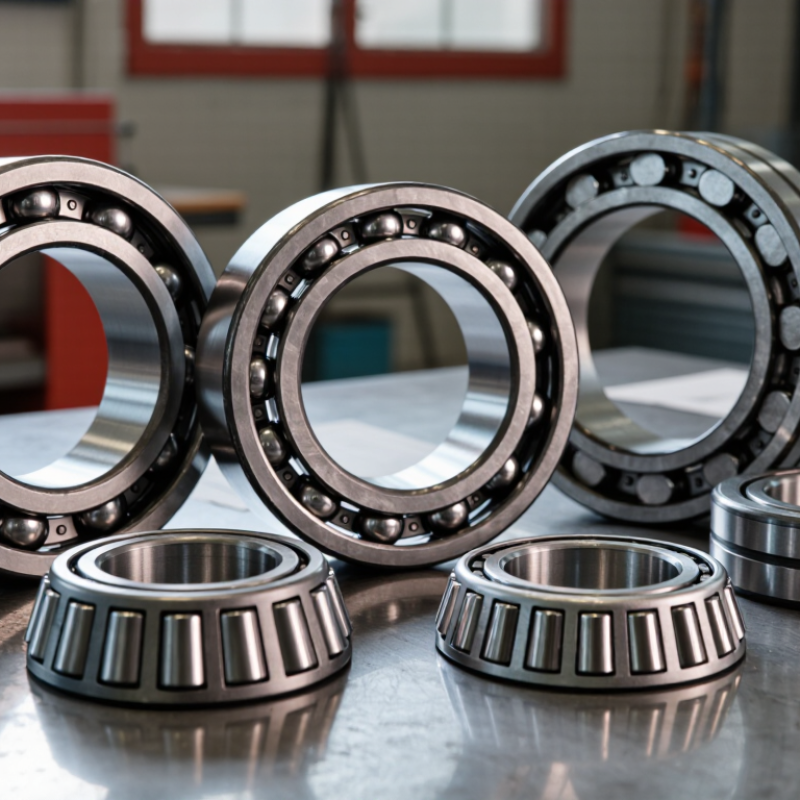
What Type of Bearing Is Best for Heavy Load Conditions?
Heavy Load Bearing Basics: Forces, Speeds, and Operating Conditions
Choosing a bearing for heavy loads starts with identifying every force. Radial load pushes across the shaft, while axial load acts along it. In a conveyor drive, belt tension may combine with thrust from misalignment. Shock loading changes the calculation. Use equivalent load values, not only the machine’s average load. Cylindrical roller bearings often handle high radial loads effectively. Tapered roller bearings suit combined radial and axial forces. Spherical roller bearings can tolerate limited shaft deflection and housing misalignment.
Speed also controls bearing selection. A heavily loaded bearing running too fast can generate damaging heat. Check the limiting speed, cage design, internal clearance, and lubrication method together. Grease may suit moderate speeds and sealed environments. Oil circulation can remove heat in faster machinery. Keep it clean. Contamination often causes premature wear before fatigue becomes visible. Operating temperature, moisture, vibration, and installation accuracy matter just as much.
In field inspections, uneven raceway marks often reveal poor alignment or insufficient lubrication. I have also seen oversized bearings fail because the housing fit was wrong. Bigger is not always safer. Static load ratings help assess shock or stationary loads, while dynamic ratings support fatigue-life calculations. These figures require realistic duty cycles and safety factors. If the load pattern is uncertain, monitoring temperature and vibration provides useful evidence. Yet measurements can mislead when sensors are poorly placed, so the diagnosis should remain open to revision.
| Bearing Type | Primary Load Capability | Relative Speed Capability | Axial Load Capability | Misalignment Tolerance | Best-Suited Conditions | Important Limitations |
|---|---|---|---|---|---|---|
| Cylindrical Roller Bearing | Very high radial load capacity and high radial stiffness | High, depending on internal design, clearance, lubrication, and cage type | Usually limited; some separable designs can accommodate axial displacement or moderate axial load | Low; shaft and housing alignment should be carefully controlled | Heavy radial loads, gearboxes, electric motors, generators, and high-stiffness shaft supports | Not the first choice for substantial combined loads or significant shaft deflection |
| Spherical Roller Bearing | Very high radial load capacity with good shock-load resistance | Moderate; generally lower than cylindrical roller bearings because of sliding and internal geometry | Moderate to high, depending on the bearing arrangement and contact angle | High; self-aligning capability compensates for housing or shaft misalignment | Heavy radial loads, impact loads, conveyor systems, crushers, fans, and applications with shaft deflection | Higher friction and heat generation than many other roller-bearing types at high speed |
| Tapered Roller Bearing | High radial load capacity combined with strong axial load capacity | Moderate to high when correctly adjusted and lubricated | High; designed for combined radial and axial loads | Low; alignment and preload or endplay adjustment are important | Wheel ends, reducers, gearboxes, pinions, and shafts exposed to combined loads | Incorrect adjustment can cause excessive friction, overheating, or reduced service life |
| Thrust Spherical Roller Bearing | Very high axial load capacity with substantial radial-load capability | Low to moderate compared with radial ball bearings; depends strongly on lubrication | Very high; intended primarily for heavy axial loads | Moderate; can accommodate limited shaft or housing misalignment | Heavy vertical shafts, screw presses, turbines, and machinery with dominant axial forces | Requires correct orientation, adequate lubrication, and sufficient minimum load to prevent skidding |
| Needle Roller Bearing | High radial load capacity for a small radial cross-section | Moderate to high, subject to lubrication, roller guidance, and raceway quality | Very limited unless combined with a separate thrust bearing | Low; requires accurate alignment and a suitable hardened raceway | Space-limited designs, transmissions, planetary gears, and high radial load in a compact package | Sensitive to shaft deflection, edge loading, contamination, and inadequate lubrication |
| Deep-Groove Ball Bearing | Moderate radial load capacity with lower shock-load tolerance than roller bearings | High; commonly selected where speed is more important than maximum load capacity | Moderate in both directions, but not ideal for very heavy axial loading | Low; excessive misalignment can increase noise, heat, and contact stress | Moderate loads, high-speed shafts, electric motors, pumps, and clean operating environments | Generally unsuitable for severe shock loads or the highest radial and axial loads |
| Spherical Plain Bearing | High static and oscillating-load capacity; suitable for slow movement | Low rotational speed; performance is governed by sliding velocity and contact pressure | Can support combined loads when correctly selected | Very high; accommodates angular misalignment and oscillation | Linkages, construction equipment, suspension joints, and heavily loaded oscillating mechanisms | Not suitable for continuous high-speed rotation; wear and lubrication requirements must be evaluated |
Cylindrical roller bearings usually support high radial loads through line contact. They suit conveyors, gearboxes, and large rotating shafts. Bigger is not always better.
Tapered roller bearings handle radial and axial forces together. They suit wheel hubs and heavily loaded gear systems. Proper alignment remains essential.
Choose spherical roller bearings when shaft deflection or housing misalignment may occur. Their self-aligning design can reduce uneven stress. Real installations are rarely perfect.
Yes, thrust roller bearings are designed mainly for axial force. Confirm the expected load direction and shock frequency. Axial loads can still change during operation.
High speed can create damaging heat in a heavily loaded bearing. Check limiting speed, cage design, clearance, and lubrication together. Heat matters.
Grease may suit moderate speeds and sealed environments. Oil circulation can remove heat in faster machinery. Contamination often causes early wear.
Dynamic load ratings help estimate fatigue life during rotation. Static load ratings help assess dents from shock or stationary loads. Use realistic duty cycles.
Incorrect shaft or housing fits can create uneven raceway marks and excess stress. Excessive preload also produces heat. I might blame alignment too quickly, so measurements should confirm the diagnosis.
Through-hardened steel offers a practical balance of strength and cost. Case-hardened steel can resist repeated surface fatigue. Ceramic rolling elements reduce friction but tolerate impacts less forgivingly.
Monitor temperature, noise, lubricant condition, and vibration. Inspectors should check sensor placement carefully. Poorly placed sensors can mislead the diagnosis.
Choosing the right bearing for heavy load conditions begins with understanding the application’s forces, operating speed, temperature, shock levels, and available space. Radial loads require strong support across the shaft, while axial loads demand designs that can manage thrust in one or both directions. Roller bearings are often suitable for high radial loads, while tapered or spherical designs can handle combined radial and axial forces. The best choice depends on the actual load pattern rather than load capacity alone.
Material strength, internal design, dynamic and static load ratings, lubrication, sealing, alignment, and maintenance requirements all affect long-term durability. Proper lubrication reduces friction and heat, while effective seals help protect against dust and moisture. Alignment should be checked carefully because uneven loading can shorten service life. Ultimately, which bearings are best for heavy load conditions depends on the application’s load, speed, environment, installation limits, and maintenance plan. Evaluating these factors together helps ensure reliable performance and a longer operating life.

 Ebmotrix Bearings